
Compare the Values on a Lyon County Property Record
No single figure captures a Lyon County property value. The PVA card splits land, buildings, extra features, taxable value, exemptions, and net assessed value into separate lines. Transfer history may add declared sale consideration. Every number belongs to a date and a purpose, so compare like with like.
| Value | What It Is | Where |
|---|---|---|
| Fair cash or assessed value | Kentucky's annual tax assessment under the fair-cash-value standard | Lyon County PVA parcel card |
| Land and improvements | Separate components for the site and buildings or features | PVA assessment detail |
| Taxable or net assessed value | Assessment after applicable exemption fields | PVA parcel and tax account |
| Declared sale value | Consideration recorded with a transfer, not an annual appraisal | PVA transfer history and deed record |
KRS 132.450 uses fair cash value as Kentucky's assessment standard. The state PVA manual discusses assessment levels and sales ratios, but the inspected sources did not publish a Lyon-specific ratio. Do not invent one or convert a sale into a current assessment by applying an assumed percentage.
Read Lyon County's Six Value Fields Separately
A Lyon County parcel record can display six distinct fields. These are Land Value, Total Building Value, Extra Features, Taxable Value, Net Exemptions Value, and Net Assessed Value. Write down each label beside its assessment year. A zero in one component does not erase the land's legal or economic weight.
The Point Legado/Dayton Valley sample parcel shows why. It lists 1.25 acres of roads and easements under PUD zoning with zero value fields. Yet its transfer history carries declared values. Land use, deed consideration, and the annual assessment are three different facts about the same property.
For a visual check, use the official Lyon County parcel detail. It shows how assessment fields, parcel facts, and transfer history sit together on one page.
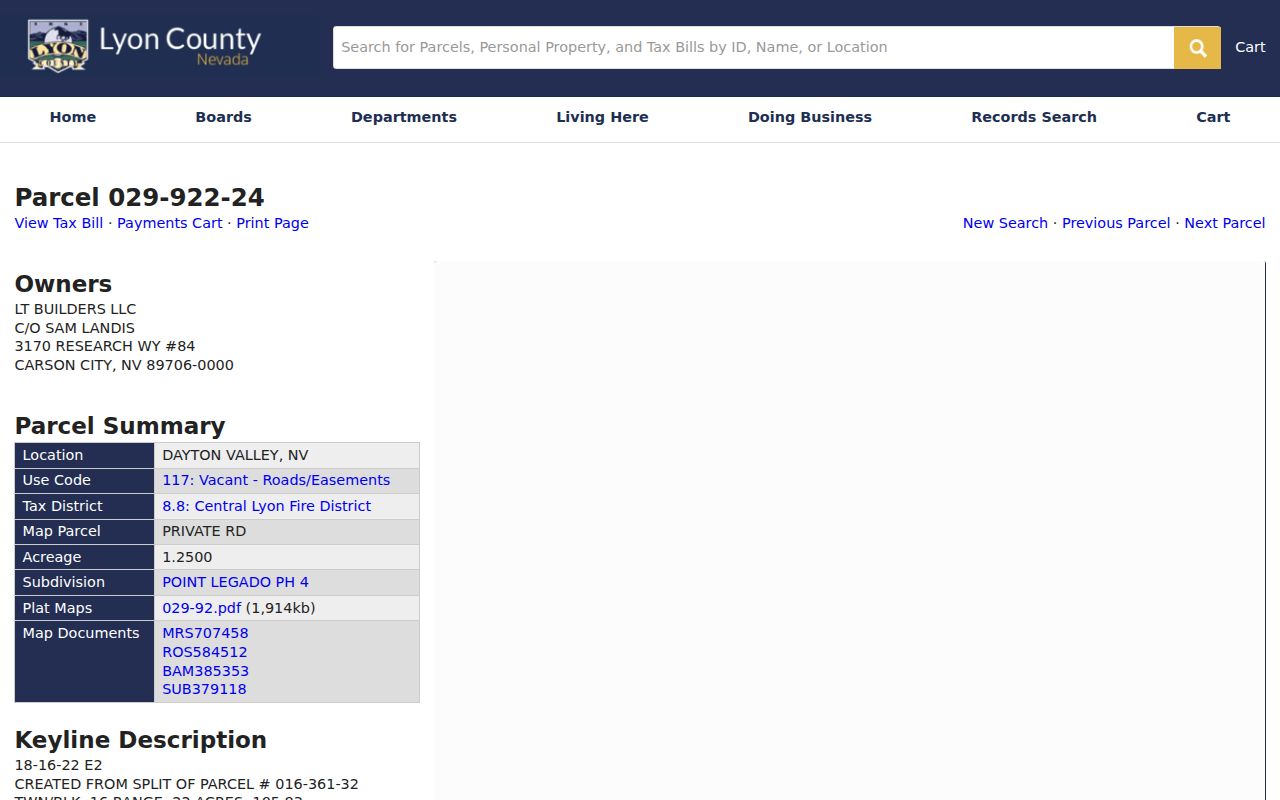
Treat the image as a map of field placement, not a current appraisal of any other parcel. Search the actual address and keep its year and APN with the result.
Annual Lyon County Revaluation Has a Four-Year Field Cycle
Kentucky PVAs revalue property every year. They add new construction annually. They also physically examine each parcel at least once every four years. So a Lyon County property value can move without any sale. Buildings change. Land characteristics shift. Neighborhood evidence and review data do too.
The sample portal record states that parcels are reappraised each year. It carries an August 31, 2026 certification statement. That date evidences the sample only, not a promise about every field. Always save the portal inspection date and tax year you relied on.
Sale Price Does Not Replace Lyon County Assessed Value
A deed or transfer row reports whatever value the filing declared. That figure reflects one transaction, its instrument, and its circumstances. It does not automatically become the next annual assessment. A trustee, executor, boundary-adjustment, or water-rights deed is not always an open-market sale. It may not behave like one at all.
The PVA advanced search supports a more careful comparison. Filter by sale date and price, vacant or improved status, and market sale. Then compare similar land within the same city, subdivision, or neighborhood. After that, return to each parcel's assessment history.
Note: Keep deed date, declared consideration, and assessment year in separate columns. Parcel condition also deserves its own column when comparing Lyon County property values.
Find a Lyon County Property Value by Address
The official Lyon County Property Appraiser/PVA Records Search takes an ID, owner name, or location. Start with the address when the parcel number is unknown.
- Enter the street number and the Location Street Name prefix.
- Confirm the result with its Map Parcel, situs, city, subdivision, and legal description.
- Record Land Value, Total Building Value, Extra Features, Taxable Value, exemptions, and Net Assessed Value with the year.
- Read transfer history as a separate sale-record source, then check the indexed deed when consideration matters.
- Use sale filters to compare similar vacant or improved market transactions, not every transfer.
- Assessed value
- The PVA's value under Kentucky's fair-cash-value assessment standard.
- Declared sale value
- Consideration associated with a recorded transfer.
- Assessment ratio
- A measure comparing assessments with sales; no Lyon-specific figure was located.
- Reassessment
- The process of reviewing and changing a property's assessed value.
Homestead Exemption Changes Taxable Lyon County Value
Kentucky's homestead exemption stands at $49,100 for 2025 and 2026. Eligible owners get that amount shaved off the taxable figure. The parcel itself does not change. Neither does the deed or the recorded sale. That is why gross assessment and the tax-bill basis are not synonyms.
The PVA handles eligibility and applications. The tax bill appears in the Lyon County property tax records guide. The appeal path appears there too. For value analysis, record the exemption field and compare gross value against net assessed value.
Lake and PUD Records Add Context, Not a Price
Lyon County land records hold PUD roads and easements. They also include water-rights deeds, subdivision and resubdivision maps, surveys, and reversion-to-acreage maps. These documents explain why two nearby lake-oriented parcels can differ. The differences show up in usable acreage or assessment components.
Kuttawa Heights, The Springs, Tarry-On-Too, Bayview, and Poplar Creek/Barkley Lake tracts supply local search vocabulary. Eddy Bay, Commerce Landing, Palisades, Paradise Hills, and Wildwood Hills frame Eddyville-area comparisons. A zoning label or lake reference can shape research. Neither one proves a market premium.
When a Lyon County Value Looks Wrong
Start by confirming the APN, assessment year, land area, building detail, exemption status, and most recent transfer. Save the PVA card and the assessment notice. Kentucky's appeal materials request the parcel identification number plus the owner's opinion of fair cash value for land, improvements, and total.
The PVA publishes no county conference calendar, so contact the office for the current inspection period and conference instructions. Do not borrow another county's dates. The formal appeal deadline follows the local inspection window.
Historic Lyon County Assessments Need a Year-Specific Request
Older Lyon County value questions rarely end with the current parcel card. The Kentucky Department for Libraries and Archives holds Lyon County tax assessment books across many stretches: 1853 through 1875, 1879 through 1882, 1884 through 1892, 1913 through 1918, 1920 through 1923, 1925 through 1956, 1958, 1960 through 1979, 1988, and 1990 through 2001. A missing stretch is a gap in that inventory. It is not evidence that no assessment happened.
Requests work best with specifics. Give the year, the taxpayer's spelling, the district, and the page if you know it. Before assuming the listed taxpayer held title, pair the old assessment with a deed or probate record. KDLA charges a $20 nonrefundable research fee for in-state archive requests and $25 for out-of-state ones. Scans, copies, and postage can add to that. The published response estimate runs four to six weeks.
Treat the old figures with care, too. Each assessment reflects the law, property description, and valuation practice of its own year. Laying a nineteenth-century assessment beside a modern Lyon County property value invites false conclusions. The two numbers simply do not share a basis.
Separate Lyon County Value from the Tax Account
A tax-account screen carries a lot of detail. Expect fields for original tax, total, paid, balance, current due, penalties, interest, the ad valorem rate, tax district, installments, and special assessments. Every one of those explains the bill itself, not what the parcel is worth on the market. A paid bill proves nothing about title. An unpaid balance alone does not prove a foreclosure or a tax sale.
Kentucky's January 1 assessment rule adds a wrinkle. A bill can stay in the name of the January 1 owner even after a later closing. Keep the tax year, the bill owner, the deed date, the declared sale value, and the assessed parcel as five separate facts. The sheriff handles the current account. The county clerk confirms a current delinquent payoff or a sale file.
The distinction matters most when comparing values. A large tax total may reflect rates, districts, or special assessments rather than any real shift in fair cash value, and an exemption can shrink the taxable base without touching the gross assessment.
What Lyon County Property Value Records Cannot Prove
An assessment is a tax record for one stated year. That is all it is. It promises no future sale price, no boundary survey, no title opinion, and no private appraisal of the parcel. A deed's declared consideration may mislead, too. It can come from a transaction type that is not a normal market sale.
Value vs. price. A Lyon County assessed value is not what a property is guaranteed to sell for. Obtain a qualified appraisal when a present market opinion is required.
Let each office do its own job. The PVA sets the official assessment, the clerk's deed record documents the transfer, and a qualified professional delivers a current appraisal. Keeping those roles separate stops one public number from answering the wrong question.